
Fenwick et al. contend that ‘[c]yberspaces are not therefore merely a new educational tool, but can spatially reconfigure the forms of knowing, sociality and subjectivity enacted through educational (en)counters’ (2011, p157). Distributed or aggregated educational spaces are not simply better or worse for learning. They qualitatively change the space in ways shaped by digital systems, through procedures that are irreducible to human intention or agency. The implications for education are that many social media and web services, as well as MOOC platforms such as Coursera, are being controlled, not by educators, but by large multinational for-profit companies. (Knox, J., 2014)
In case you were wondering, this is what an algorithm looks like :) #mscedc http://t.co/1ZsMbKr52X
from http://ift.tt/1AKfBYz
via IFTTT
#mscedc http://t.co/yMtvr7H09a
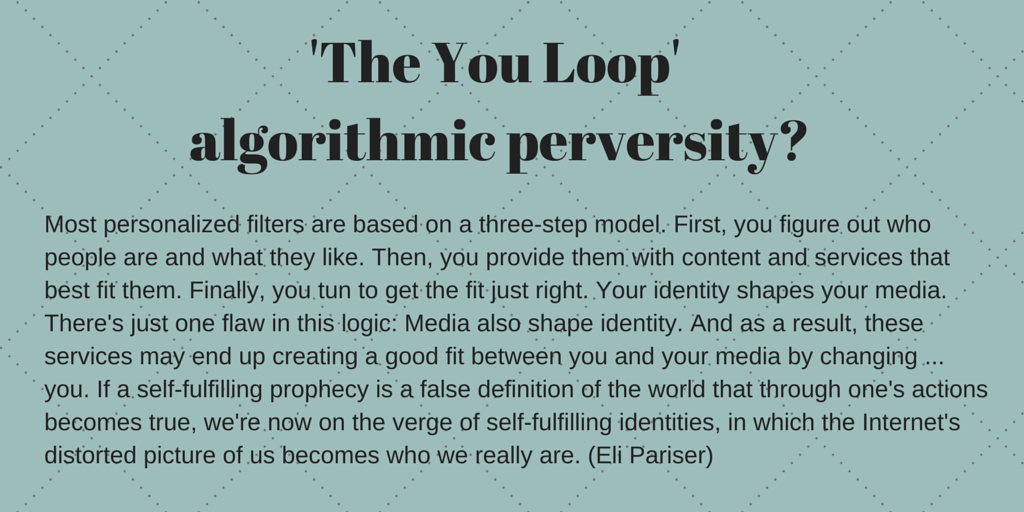
Great TED talk on how algorithms shape our world. #mscedc
via IFTTT
Week 7 Lifestream Summary
I was delighted to find the TED Talk by Sherry Turkle this week as her name came up so often during the IDEL and I’ve also just started reading Life on the Screen. The points she raises in the talk about connectedness, social media and technology are useful in exploring a rather different side to online community.
My main focus this week has been on MOOCs and ethnography, and I found that our micro virtual ethnography task raised several issues. As I wrote up my findings I realized that the observations that I’ve made on peer assessment have no real connection to the rest of the what is happening in the MOOC. I was only able to look at one assignment out of three and didn’t have the time to examine whether the peer feedback improved on assignments 2 and 3 following the community’s discussions.
The comment on reflexivity was made after reading Hammersley and Atkinson (2007) in Research Methods. I now understand that ethnography was historically situated in positivism, then naturalism sort of took over but finds itself in tension between naturalistic/constructivist understanding of meaning-making and postivist/realist understanding of methods used. The solution proposed is reflexivity. But Moore warns that reflexivity in ethnography is an indulgence, which leads to the ethnographer telling the readers more about themselves than the culture observed. But I guess as in everything there is a middle way and reflexivity can be used without detracting too much from the ethnography itself.
The FutureLearn article provided some interested statistics and it is incredible to think that students from 190 countries are participating in their courses. How great too that the oldest student is 92 – something to be said for lifelong learning.
However, I was surprised that the typical age group was between 26 and 35 as I had expected the range to be wider. It was interesting creating the infographic and much easier than I had expected, but I’m very aware after reading a couple of articles on data presentation how careful we need to be in interpreting it.
Hammersly and Atkinson (2007) ‘What is Ethnography’ in Ethnography: principles in practice. http://www.tandfebooks.com.ezproxy.is.ed.ac.uk/isbn/9780203944769
Hine, C, (2000) “The virtual objects of ethnography” from Hine, C, Virtual Ethnography pp.41-66, London: Sage
BBC article ‘UK online course provider FutureLearn reaches million’, Sean Coughlan, 19th February 2015 http://www.bbc.com/news/education-31533681
Infographics
Have been exploring different ways of presenting information this week and tried making an infographic just for fun. The information comes from the article I posted earlier in the week on FutureLearn.
I used the free version of piktochart.com and it was fairly easy and intuitive drag and drop process.

Information taken from BBC article ‘UK online course provider FutureLearn reaches million’ by Sean Coughlan, 19th February 2015
Practical considerations for virtual ethnography
How strongly should a clear focus be set from the outset or should the researcher respond to the context as it unfolds – will you choose the sample or will the sample choose you?
How will access to the site be gained? (Access may be gained to a particular institution but not to everyone within that institution.)
How long will you need to spend in the field? How/when will you leave it?
Will you study a full cycle of activity or a smaller segment of life?
How will you identify event boundaries and make them transparent?
How will connections be made between one bit of life and others in order to construct and give grounded explanations of social phenomena?
Which rich points will be identified as anchors for analysis
How will the tension that arises from being an insider and an outsider simultaneously be dealt with?
How will data be archived and retrieved? Are there any issues with data security?
Virtual Ethnography on Peer Assessment in Coursera Gamification MOOC

Tried to do the ethnography in Storify but it meant uploading all the headings and screen shots to flickr, which was incredibly fiddly and time-consuming. The pdf format, while not what I originally wanted, as least does the job!
UK online course provider FutureLearn reaches million
FutureLearn, the UK’s online university platform, has reached a million students signing up for courses. The provider of so-called Moocs (massive open online courses) says interest has been rising sharply, with 20% more UK students in the last three months of 2014.
from Pocket http://ift.tt/1LgY64R
via IFTTT
Interesting perspective – Some view reflexivity in ethnography as an indulgence, a ‘self-reflexive cul-de-sac’ (Moores, 1993: 4) in which the ethnographer ends up telling readers more about herself than about the culture purportedly described (Hines, 2000).
from Facebook
via IFTTT