Domain Knowledge
This covers the information being imparted to the participants, and also: knowledge of where the information can be found; the communities of practice within that area; how to discover the information; and how to manage the information.
The information
The information so far, has been presented in video and pdf formats.
Videos
A quick search on Google shows that some research has been started on how best to create / present a mooc video. One such article by Guo (2014) has examined more than 800 videos and pulled out some basic guidelines. The first and most important, is that videos should be less than 6 minutes in total. The Metaliteracy Mooc meets this guideline with half of its videos:
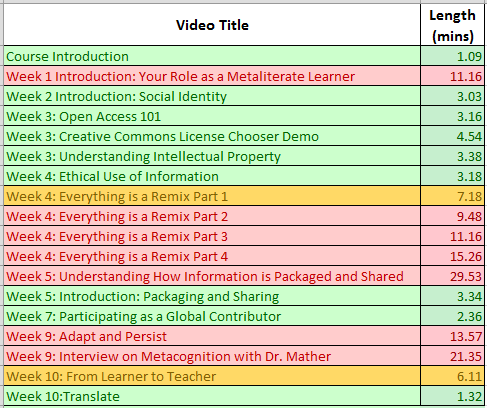 The videos use a mix of presentation styles. Some are PowerPoint style with voice overs. Some are high energy documentary style. Overall, they are relevant, engaging and produced to a good quality. Some of the videos have been produced for this Mooc, others are available on the internet.
“The video introduction from SUNY is a highly produced, arresting computer-generated graphic. A lot of thought has gone into the design composition and visual presentation of this course” (Mooc course participant A).
Pdfs
The pdf documents have been created by the Mooc team. They are short and contain links to external sources of information and activities. Please see the example below.
Usefulness
Overall the materials are meeting with approval, and participants are finding them useful.
 However, there does seem to be an access problem with participants trying to read the course materials which are all in pdf format:
 which was found to be an issue with the Android app:
 even the coursera staff acknowledge to be a problem. But one that is still to be rectified by Coursera staff:

Where information can be found
The pdf documents contain hyperlinks to external information. Some of these sites are generally relevant to all regardless of location, but many of them contain information that is specific to the USA.

In my opinion, the course should acknowledge this fact, and encourage international students to discover information that is relevant to their own situation. This could be easily achieved in the discussion forums. In fact, the following post by a course instructor says that they “invite everyone in the course to share their own knowledge about their “local” copyright practices”, but I have checked and double-checked the course information and activity pages and this is not mentioned or indicated anywhere that I can find. I have only found a single post where a student does do this.

The course information for this week covers open access and creative commons but does not mention other types of copyright and intellectual property protection like trademarks and patents. For example, one of the course assessment questions asks you to apply a creative commons (CC) license to a piece of work you have created. I looked at protecting a piece of computer code but found that CC does not apply to this (https://wiki.creativecommons.org/Frequently_Asked_Questions#Can_I_apply_a_Creative_Commons_license_to_software.3F). I was able to find this information by following the links provided by the mooc, but it was not easy, and I was only able to find it because I have pre-existing knowledge that allowed me to ask the right questions.
In this particular instance, I do believe that the course should include information on what it will not cover, just to acknowledge the facts that there are more considerations to make and the international nature of a Mooc.
Communities of practice