
from http://ift.tt/1AKfBYz
via IFTTT
Monthly Archives: March 2015
Big data relies on algorithms to make sense of it. #mscedc
from http://ift.tt/1AKfBYz
via IFTTT
Are algorithms our digital nervous system? #mscedc
from http://ift.tt/1AKfBYz
via IFTTT
Programme or be programmed? #mscedc
from http://ift.tt/1AKfBYz
via IFTTT
Learning Analytics Ethical Issues
- Data ownership and sharing between systems, organisations, and stakeholders
- Location and interpretation of data
- Informed consent, privacy, and de-identification of data
- Classification and management of data
- What will be done with the data – how can the potential value of the data be leveraged without succumbing to the dangers associated with tracking students’ learning options based on deterministic modeling? Obligation to act?
- Understanding accuracy and limitations of the data – misinterpretation could lead to inappropriate response from teachers
Where LA is more concerned with sensemaking and action, educational data mining (EDM) is more focused towards developing methods for exploring the unique types of data that come from educational settings. (Siemens, 2013)
from Facebook
via IFTTT
Are statisticians and data scientists now doing the job of sociologists? #mscedc
from http://ift.tt/1AKfBYz
via IFTTT
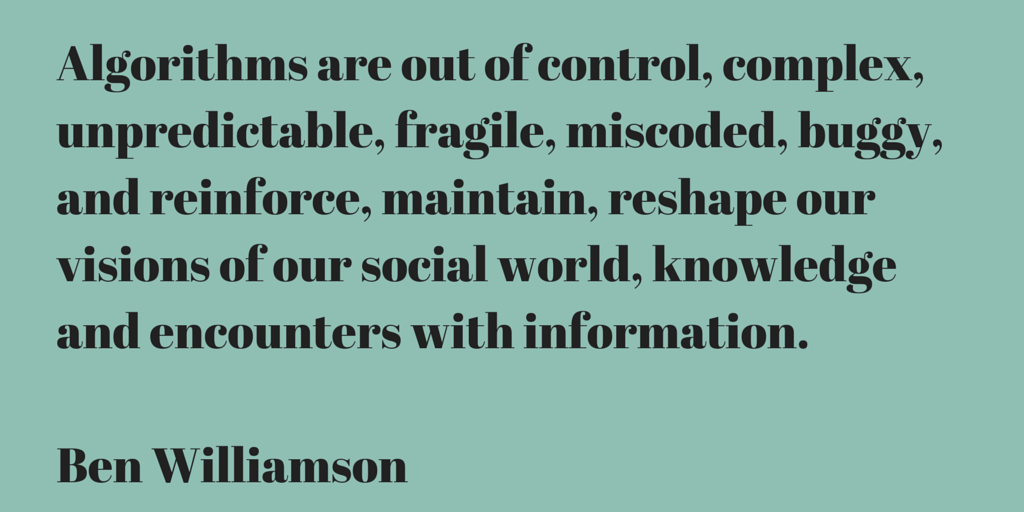
#mscedc http://t.co/LtJarnwefN
from http://ift.tt/1AKfBYz
via IFTTT
Week 8 Lifestream Summary
Kevin Slavin’s TED Talk on algorithms is fascinating and I had never imagined that algorithms could have a physical impact on our environment. Blasting through rock to install cables so that information can travel nano seconds faster worryingly proves that Jarre’s photo of the Himalayas reshaped to echo the vicissitudes of the Dow Jones is no longer a metaphor but a prophecy.
As Slavin points out we’re writing something we are no longer able to read and now have algorithms locked in loops with each other with no control over what they are doing (think Flash Crash 2010).
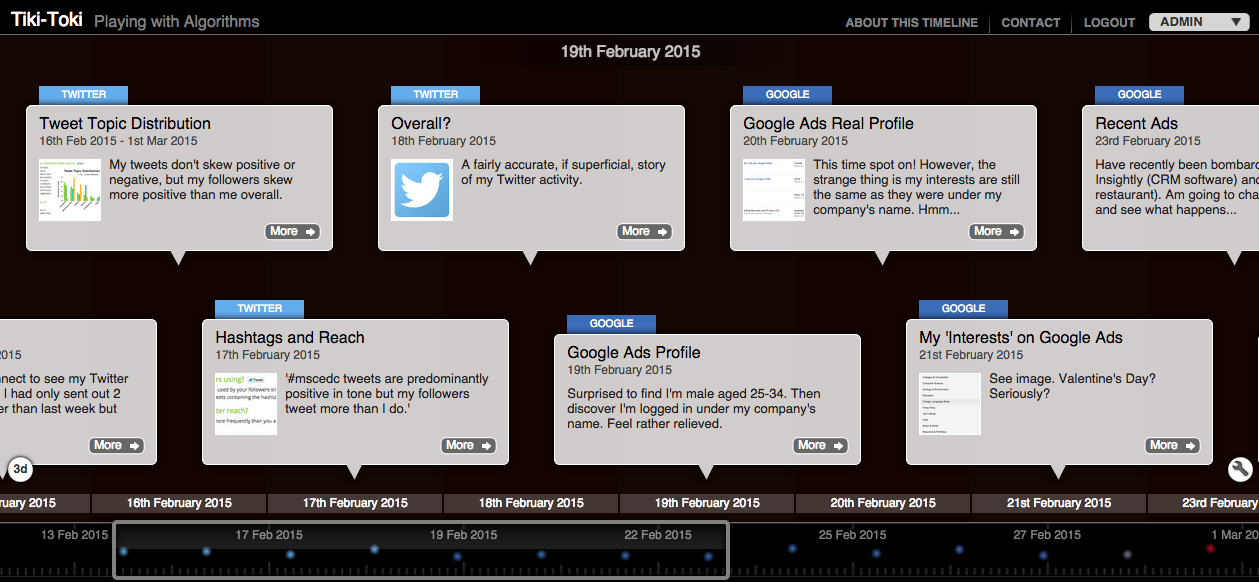
It was fun playing with algorithms this week and I created a timeline on Tiki-Toki to show the different areas I explored. One of the most interesting things I noticed was with the Youtube algorithm. When I was logged in to my Google+ account the recommended videos were related to videos that I had previously viewed. By logging out of Google+ the options I were given were mainly in Mandarin and clearly linked to my location. In a way I preferred to have the results that related to me personally in comparison to those in Mandarin, but if I were living in an English speaking country (or somewhere like Italy or France, where I speak the language and understand the culture) I would probably feel that the personalised results were too limiting and that I was caught in a ‘you loop’.
There are definitely issues at stake here (as for example with Amazon). What if you order a book dealing with a difficult event in your life (illness, grief) and are then recommended further books on a subject you don’t particularly want to be constantly reminded about? There is also the issue that being in ‘you loop’ may start to impact on your identity and the internet’s distorted picture of us actually creates who we are.
Another thing that really surprised me with Youtube was the comments I was presented with. I had a look at a TED Talk and when I was logged in the comments were better written and supportive of the talk, while when I was logged out they were more critical, contentious and used bad language. (Nice to think though that my algorithm knows that I don’t appreciate the use of swearing in forum comments!)
Similar to Youtube, Coursera recommends courses similar to courses I’ve already done but clearly the difference here is while you may like to watch similar videos, it’s fairly unlikely that you are going to do several courses on the same topic. Here, and in digital education in general, the ‘you loop’ would be very restrictive, limiting the options that are presented to you.
Knox, J. K. (2014). Active algorithms: sociomaterial spaces in the E-learning and Digital Cultures MOOC. Campus Virtuales, 3(1): 42-55.
Eynon, R. (2013) The rise of Big Data: what does it mean for education, technology, and media research? Learning, Media and Technology. 237-240.
Here’s the link to the timeline for my algorithm play http://t.co/NjwlKmOgF2 Will blog in more detail in the weekly summary #mscedc
from http://ift.tt/1AKfBYz
via IFTTT