Just thought I’d post a quick explanation as to what the various elements of my artefact are designed to represent:
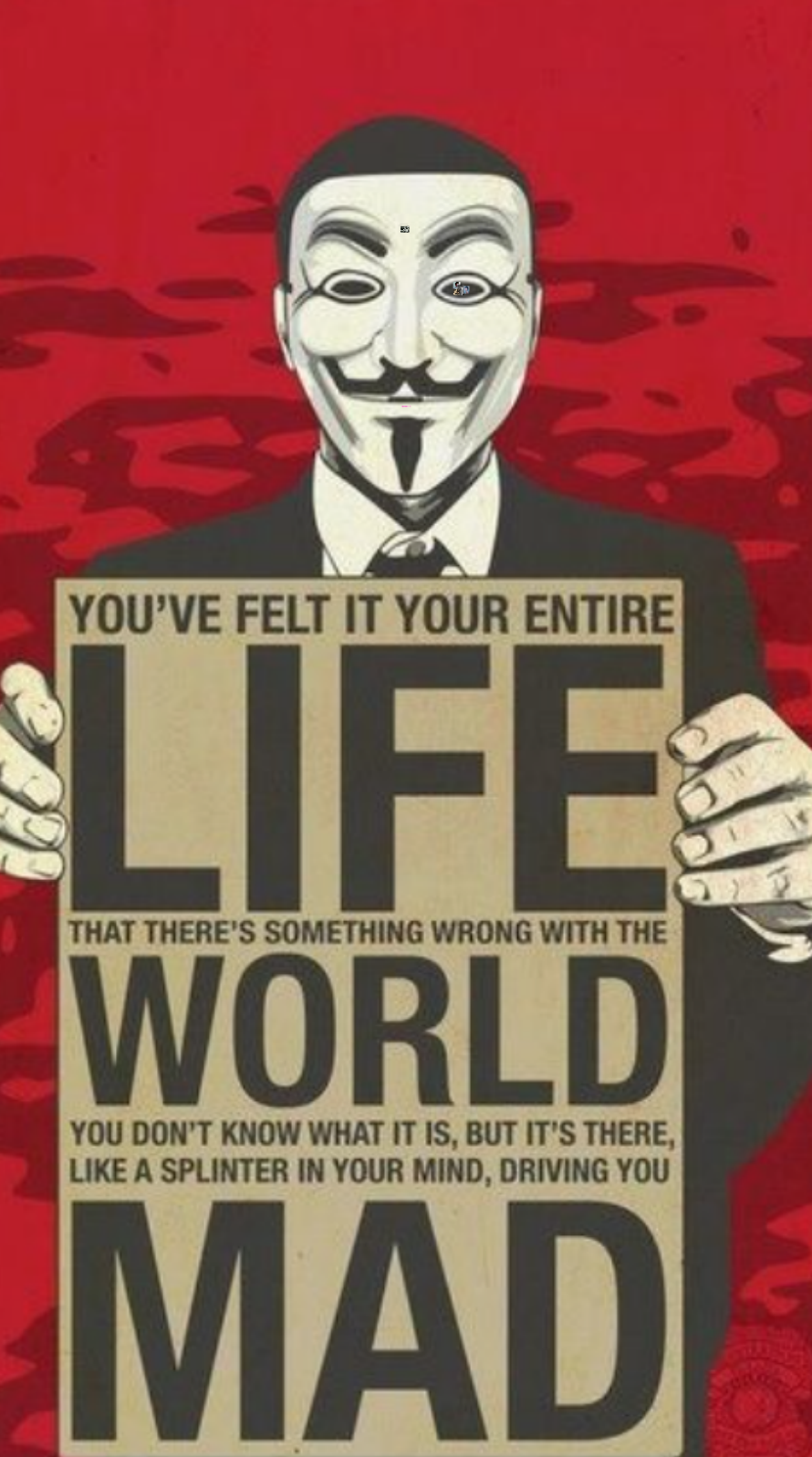
Intro Frame
Title page: this is an image of the hactivist collective Anonymous – designed to represent the potential within digital culture to resist, as well as re-enforce, broader commercial interests and territorialisation of cyberspace.
Youtube film: This was selected in order to highlight the playfulness and irony that, according to Haraway (2007) and Hayes (1999), are key features of post-humanism and digital culture more broadly. Also, aligning with the notion of the mashup, the video is intended to provide a background track (Anything goes) to run through the remainder of the display.
YouTube video on digital culture
Human: This montage speaks to the various themes throughout the readings, films and online discussions regarding what it means to be (post)human. Key representations from science fiction (e.g. Terminator and the Borg Queen) are included, along with images of cyborg humans. What I particularly sought to capture is one representation of the human body (comprised of flesh, bone and muscle) looking away from the (post/trans)human comprised of digital information. This is intended to highlight the tension and antagonism between constructions of the human self within humanist and post-humanist discourse. I used an audio clip of a heart beating (the quintessential notion of humanity) to emphasise some of these tensions.
Progression? The next composite relates to the relationship between digital technology and human progress. I used a typical evolution of man diagram with an arrow linking to a giant server, in order to highlight questions as to whether cyberspace represents the next step in the evolutionary process. On the margins of this diagram are two alternative representations. One (top right) speaks to the concept of homo faber (tool making man) and the idea that persons have also ways existed as a complex assemblage between flesh and technology. The second (bottom left) refers to the notion of thought as the key element of existence, and thus the potential for the self to exist outwith its embodied form (an idea that can be traced at least to Descartes)
Paradise: Following Bayne (2014), This image is designed to link the themes and tensions within digital culture to the sphere of education and pedagogy. Here, I’ve sought to juxtapose idealised images of high tech classrooms and the ‘promise’ of technology enhanced learning with tumbleweed sounds – a reference to the dystopian tendencies within digital cultures. As such, the image is designed to highlight how education is a contested site, where managerialist (and emancipationist) approaches to technology in education sit alongside more counter-culture, cyberpunk infused, ideas for developing digital education.

Technology Enhanced Learning
Outro: The final frame returns to the original picture of Anonymous, only I introduced a clip from Aldous Huxley reading an extract of Brave New World – specifically the reference to baby factors and world governance. This, again, is a reference to the dystopian themes of digital culture and how technology can act as a vehicle for globalisation in education yet, also, a site for resisting it.
References
Bayne, S. (2014) What’s the matter with technology-enhanced learning? Learning, Media & Technology 40(1): 5-20.
Haraway, D. (2007). A cyborg manifesto. In: Bell,D., ; Kennedy, M. (Eds). The Cybercultures Reader. London: Routledge. Pages: 34-65,
Hayles, K. (1999). Towards embodied virtuality. How We Became Posthuman : Virtual Bodies in Cybernetics, Literature, and Informatics. Chicago, ILL: University of Chicago Press. Pages: 1-25.